
Why Men are Less Likely to See a Doctor and What That Costs Them

Ask most men when they last scheduled a checkup, not an urgent care visit for something broken or bleeding, but an actual routine physical, and you'll often get a shrug or a guess measured in years.
Men get sick just as often as anyone. What differs is how long they wait to deal with it, and the data on what tends to go undetected in that stretch of time is more concrete than most people realize.
Do Men Really Avoid the Doctor?
The idea that men avoid the doctor isn't just a stereotype, federal health data backs it up. Women are an estimated 33% more likely than men to visit a doctor overall, and roughly twice as likely to seek preventive care specifically, according to CDC survey data. A separate analysis of federal survey data found that 28% of men reported not having a personal doctor or healthcare provider, compared to 17% of women.
The gap shows up again in how conditions get caught, or don't. Men are diagnosed with high blood pressure more often than women, 50% versus 42.1%, according to the CDC. Yet they're also more likely to be walking around with it and not know it. Federal data from the early 2010s found 19.2% of men with hypertension didn't know they had it, a higher share than women.
That broader problem hasn't gone away. More recent national data shows about 41% of all adults with hypertension are still unaware of their condition, and men remain less likely than women to know they have it.
Diabetes tells a similar story. Among adults aged 20 and older, age-adjusted CDC estimates put undiagnosed diabetes at 4.9% for men, compared to 3.5% for women.
None of this means men are careless about their health. It means a lot of conditions that are easy to catch early are, for men in particular, going unnoticed for longer than they should.
Why Men Put Off Seeing the Doctor
The reasons men give for skipping checkups are fairly consistent across surveys, and none of them are unreasonable on their own. Time is a big one. A same-day illness might justify missing work, but a routine physical, when nothing feels wrong, often doesn't feel worth the hours lost to travel, waiting rooms, and paperwork. Cost is another. Even with insurance, co-pays and the fear of "what if they find something expensive" keep some men from booking a visit they consider optional.
Then there's the simple fact that many men don't feel sick enough to justify going in. Conditions like hypertension and early type 2 diabetes typically produce no symptoms at all in their early stages, so there's no obvious signal telling a man he needs care. And for some, it's discomfort with the clinical environment itself. One survey found that a striking number of men would rather do chores around the house than sit through a checkup, which says less about the checkup and more about how the experience has traditionally been designed.
Put together, the men most likely to skip care are often the ones with the least visible symptoms and the least flexible schedules.
What Delayed Care Actually Costs
The reason this gap matters isn't abstract. Heart disease is the leading cause of death for men in the United States, accounting for roughly 27% of all male deaths, and a heart attack occurs in the U.S. about every 40 seconds. Roughly one in five heart attacks are "silent," meaning the damage happens without the person realizing it in the moment. High blood pressure and elevated cholesterol, the two risk factors most directly caught by routine bloodwork and a blood pressure cuff, are also the two most likely to go unaddressed when a man isn't seeing a provider regularly.
Type 2 diabetes follows a similar arc. It can develop gradually over years with few noticeable symptoms, which is part of why it frequently goes undiagnosed for years after it actually begins. The condition itself is manageable and, for many people, largely preventable through early lifestyle intervention, but that only works if someone knows to intervene in the first place.
The reason early detection matters so much here is that these conditions respond well to being caught early, through basic, inexpensive tests that most men are simply not getting on a regular schedule.
Getting Screened: What to Check and When
Guidelines vary by individual risk factors and family history, so these are general starting points from the U.S. Preventive Services Task Force (USPSTF) and CDC, not a substitute for a conversation with a provider about personal risk.
Age Range | Generally Recommended |
20s to early 30s | Blood pressure check at every visit; cholesterol screening if there's diabetes, obesity, smoking, or a family history of early heart disease |
35 and up | Routine cholesterol/lipid panel, regardless of other risk factors |
35 to 70, with overweight or obesity | Diabetes and prediabetes screening |
45 and up | Colorectal cancer screening begins, per the USPSTF's updated guidance |
55 to 69 | A conversation with a provider about whether PSA-based prostate cancer screening makes sense given individual risk and preferences |
The common thread across nearly all of these is that they require almost no recovery time and, for the most part, don't require a specialist. A blood pressure cuff, a basic blood draw, and 15 minutes of a provider's time cover most of the list.
Where Telehealth Fits in
Telehealth doesn't remove every barrier men cite, but it directly addresses several of the most common ones. There's no commute, no waiting room, and no need to take a half day off work for a conversation that might take 15 minutes. Lab work can often be done locally or at home and reviewed with a provider by message, rather than requiring a second in-person visit just to hear the results.
For a man who's been putting off a physical for three years because he can't find a weekday appointment that doesn't cost him half a shift, removing that friction can be the deciding factor in whether he gets a blood pressure cuff on his arm this year at all.
How LifeMD Can Help
Virtual care works best as an ongoing relationship rather than a single transaction, especially for the kinds of conditions, like blood pressure, cholesterol, and blood sugar, that need to be tracked over time rather than checked once and forgotten.
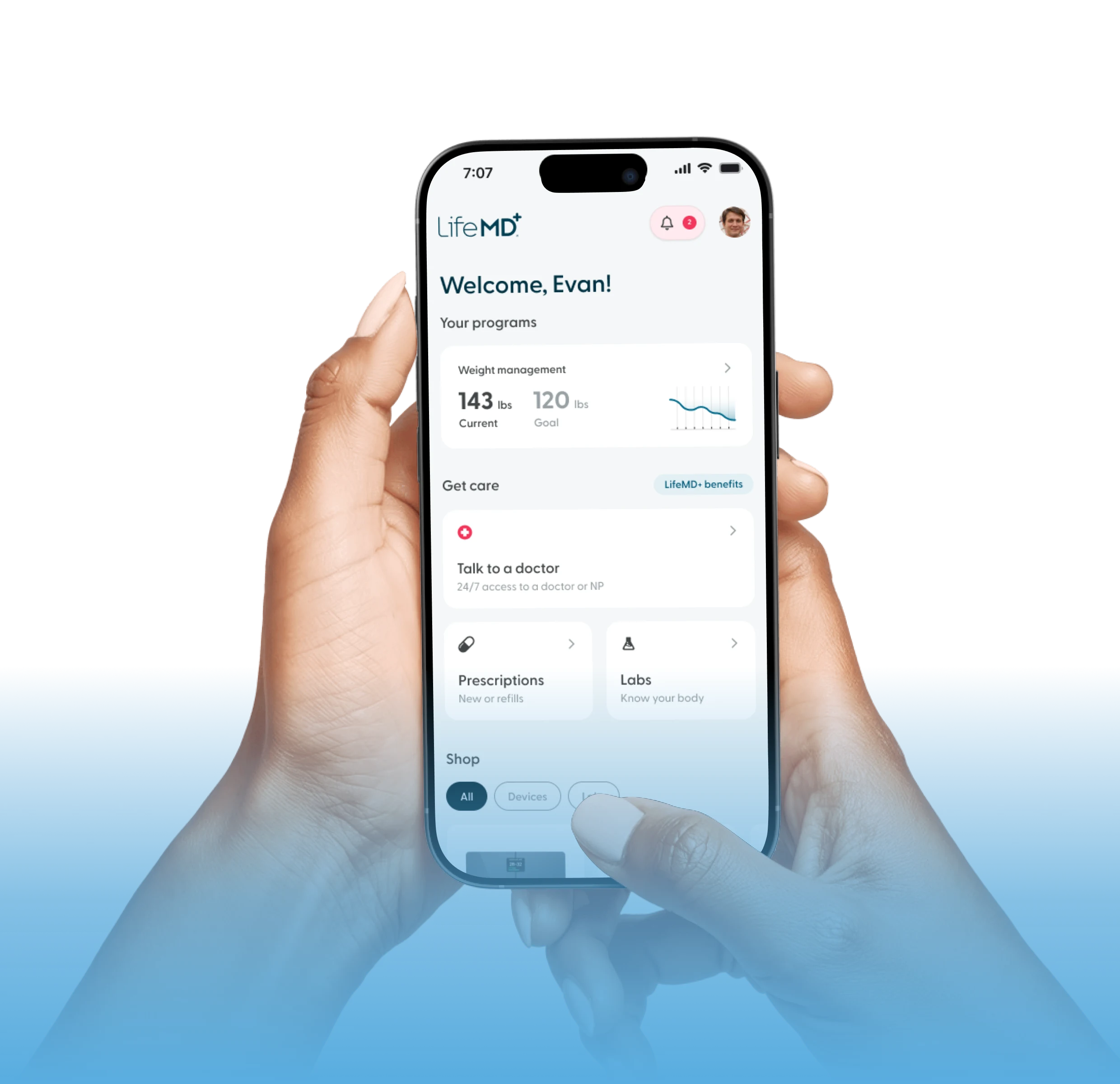
For same-day concerns and ongoing primary care, LifeMD+ gives patients 24/7 access to licensed providers without a waiting room in the picture.